Monday, June 11, 2018

Walking Away Toothache


            “As sickness is the greatest misery, so the greatest misery of sickness is solitude … .”  Thus begins one of John Donne’s “meditations” written during a time when fever confined him to his bed in a sickroom, unable to practice his vocation and unable to be sociable.  Sick people were quarantined in early-modern England—a time when populations were devastated by plague and there was no understanding of how infection spread or even what was infectious.
            I had occasion to identify with John Donne lately when, afflicted with a bad toothache that would not abate, I couldn’t see straight, think clearly, or even enjoy the simple pleasures of life … or so I thought until one walk on a breezy sunny afternoon saved me.  The experience of this one walk and its effect on my spirits proves to me the power of that triadic chord—mind, body, and world—played over and over every time the human being leaves her house, her desk, her yard, and strikes out for fresh woods and pastures new.  Leap the fence, be cattle no more but wild cow, back to nature, and you will find, as I found, that even in solitude, you are not alone but drawn out into an ocean of subtle intelligences to swim in a sea of infinite warmth and tenderness where grasses, weeds, the light on a stream will support and delight you.  This is possible even if you are isolated by physical pain.  “Does it work on emotions, too?” my daughter often asks if she hears me talking about cures or healing.  Oh, yes, it absolutely works on emotions.
            I walked a familiar path, focusing on each step.  I remembered watching a physical therapist move my mother’s leg when she lay in a hospital bed after breaking her hip.  “Breathe, Catherine, move through the pain.”  I repeated those words and was eased somewhat by the awareness that the pulsing pain in my tooth matched the rhythm of my legs carrying me forward.  The insight didn’t take away the pain but it naturalized it.  The walk became a real walk when I got into Kearsley Park and turned off the path to stray far into a grassy meadow, past the remains of last year’s “Occupy Flint” campsite.  There were old concrete blocks where men had sat to while away the hours in the sun.  I saw pieces of their tents and remembered how I’d given their encampment a wide berth on walks last summer.  As I was coming into what felt like the oldest part of the sward, deep indentations—almost like filled-in cellar holes—and straggling old trees covered with vines gave the impression of a landscape worked by human hands.  Suddenly I heard noise—squabbling and whinnying—underground.  Surprised, I looked for a human source of this sound on the far hillside, but there was no one in sight.  Then, I saw the hole and the brown fur back of a woodchuck.  This was not Avernus, not the entrance to an underworld where souls writhe in pain, but a simple den and where an animal altercation—between a landowner and a squatter or between mates—was underway.  The animal hadn’t seen me, but I was eager to see him and to witness how this conflict would play out.  I climbed up on the big fallen tree trunk nearby to wait.  I waited for what seemed like a long time, focused on the hole, but their negotiations or whatever was happening underground, gave me time to enjoy the sun, the breeze, and to study the wood on which I was sitting.  The tree had been down for a long time—split and open to weather and bugs.  I sat and thought about inner rot and underground squabbling.  These images seemed, at that moment, gifts from some cosmologic compassion given to make me feel better.  And I became better because I started to feel other things again:  I felt the sun.  I saw the beauty of simple grasses.  I noticed the color of my own hair as loose strands blew about my face.  There was more going on than the throbbing beneath the root of my tooth.  The sound of animal whinnying broke into my thoughts, and a brown head appeared at the top of the hole, its black eye staring directly at me.  We sat like that—he and I –for a long while.  I dared to move close enough to see the twitching nose, the gray-brown fur of the head change to red on the neck.  He didn’t move, but then I did.  I walked away, letting him finish whatever he was settling or trying to run from. 


            Being caught in the gaze of a creature and sitting in an arboreal cavity changed my day.  The incidents were unpredictable, but felt like gifts.  Such meetings are what make life incalculable, what give it value.  At home I felt less alone and more responsive to the love that was available from corgi, husband, and teen daughter who loves to cuddle.  When I told my husband what I’d seen, he seemed interested and said that there are places in the country where woodchucks are called “whistle pigs.”  I made tea and took it to the front porch where I could still feel like I was outside among the leaves.  I sat down on the floor with my pets and I was happy enough to sing what I could remember of “How Great Thou Art:” 

O Lord, my God, when I in awesome wonder
Consider all the worlds Thy Hands have made
I see the stars, I hear the rolling thunder
Thy power throughout the universe displayed

Then sings my soul, my Saviour God, to Thee
How great Thou art, how great Thou art
Then sings my soul, my Saviour God, to Thee
How great Thou art, how great Thou art


            In my nights of misery, I’d thought of Shakespeare’s Iago who says he’s kept awake by a “raging tooth,” and I knew that Shakespeare had had a lot of other things to say about tooth aches.  His most quotable line comes from Much Ado About Nothing when a grief-stricken father, who has lost a daughter refuses to be consoled:  “There was never yet philosopher that could endure the toothache patiently,” says Leonato to silence his well-meaning counselors.  But my experimental walk with toothache suggests that Leonato may not be quite right and that when we use our legs as instruments of philosophy, that which carries us beyond ourselves cures us.  
           The tooth pain slowed me down and woke me up to some basic things.  I learned something about finding, what it means that we are looking for something we have lost--faith in what's happening in the worlds we trod upon but never really observe.  I learned what acceptance is, what it means that we have to find ourselves where we are, at each present, and accept that finding in our experiment.  Most important of all--I learned that to be confident in nature is to be willing to be confided in by her.  To listen to all the hums, throbs, and whistles that indicate subterranean activity and to trust that awareness of that activity, whether it come in the form of a toothache or arguing woodchucks, will move us toward resolution and peace.

----------------------------------------------------------------------------------------------------------------------

postscript:  "Love and toothache have many cures, but none infallible, except possession and dispossession."  --Ben Franklin

Monday, May 28, 2018

Finding Thread Lake in the Heart of Flint


“What’s the need of visiting far-off mountains and bogs, if a half-hour’s walk will carry me into such wildness and novelty?”                                           --Henry David Thoreau

            There is a lake practically at the center of Flint—Thread Lake—just a stone’s throw south-east of downtown.  It began its life in a time before Flint became “Vehicle City,” when an enterprising miller, Rufus Stevens, dammed Thread Creek in 1830 to power a mill.  Stevens was the first white settler in Grand Blanc, and when he established his mill, there was wilderness all around Thread Lake.  As the carriage industry gained a toehold, an amusement park was built on the west end of the lake, and a trolley line brought thousands to enjoy the rides, the shows, the dancing, the boating at Lakeside Park from 1905 through the Depression.  Today, there is no evidence that such a park existed—just a big paved parking lot and the tin shed that was once McKinley senior center (now closed and the building scorched by arsonists).  Why did Flint give up on Lakeside Park?  Why has it forgotten its hidden gem?  The short answer is:  the automobile.  Once Flint residents had cars and the wealth to buy recreational toys and summer cottages, they couldn’t wait to go “up north.”  But this brings me back to Thoreau’s question: “what’s the need of visiting far-off mountains and bogs”?  Thoreau, for those of you who don’t know, was a resident of Concord, Massachusetts in the 1830s and 40s, who built himself a little house on the local Walden Pond—a mile from any neighbor.  In his writings, he adjures us not to go looking further and further afield for recreation and refreshment but to seek the wild source in our own backyards and, more importantly, in our own selves: “It is vain to dream of wildness distant from ourselves.  There is none such.  It is the bog in our brain and bowels, the primitive vigor of Nature in us, that inspires that dream.”[1]  The collective abandonment of Thread Lake—most Flint residents don’t know where it is!—is a symptom of larger cultural problem.  As I write this, the lake is literally vanishing due to a dam breach.  Its carp-filled waters rush through open gates, while bald eagles search the mud flats for remaining fish.  If we viewed this as a different kind of water crisis, perhaps we could muster the collective will to save this patch of wilderness in our backyard.  To help you understand why Thread Lake might matter, let me tell you a story.


Midway at Lakeside Park on Thread Lake, Flint, MI., c. 1905

            I moved to Flint from Boston in 1996 for a teaching job, and I became fast friends with my department secretary, Fran Frazier.  It was Fran who introduced me to Thread Lake through reminiscences of summer days when she’d take the street car to Lakeside Park with her father.  She remembered eating cotton candy, riding the roller coaster, and renting rowboats.  Fran lived on Stockton Street in what once had been a boarding house her parents ran for factory workers.  Her dad worked at Chevy-in-the-Hole and had used his first paycheck to buy a fiddle.  When she died, Fran gave my husband that same violin.  She said it would be a gift for me, too—music in the house—if I wasn’t like her mother, a killjoy, who was annoyed by sound.

In the years when I was friends with Fran, I was also getting to know Paul, my future husband.  Paul is archivist of The Genesee Historical Collections Center, housed in the UM-F library.  I told him all I’d heard about Thread Lake.  I remember one particular conversation over breakfast, the summer we married, when I marveled at how much water there was in Flint:  there’s the Flint River, Kearsley Creek, Gilkey Creek, nearby lakes, and, of course, Thread Lake.  “I wish we had a boat … wouldn’t that be cool … to paddle around Flint?”  When I dredged up this dream, my version of Huck Finn’s raft on the Mississippi, I never expected Paul to embrace it, but he did.  Later that same day, we were at Rocky’s on South Saginaw, buying a green aluminum Radisson canoe—light enough to throw on the car—and that evening, we were paddling it on Thread Lake!  For the next 3-4 years, from courtship through marriage up until the adoption of a baby daughter, we headed to Thread Lake many times each week of spring, summer, and fall.  We explored every bay, every mucky swamp.  Usually, we’d put the canoe in at a dock at the end of Winans Street (off Lippincott) in an historically black neighborhood, where we’d seen the carcasses of dogs deposited (dog fighting is still ghetto sport).  Sometimes we’d often see the same guy fishing off the dock, who told us tales about snappers that lived back in “the hole,” and when we asked where exactly was “the hole,” he gestured up toward the creek.  We’d head in the direction, paddling upstream, scaring ducks, observing herons, and once even startled a coyote who was doing his own hunting.  Pressing further into wilderness, Paul determined one summer that we should clear the creek of branches that blocked our passage to the interior and, sure enough, waist-deep in water, using a small chainsaw, he cut through and cleared the blockage.  Later his own circulatory system clogged, resulting in a heart attack, and the flow of energy in our marriage ceased.  But those Thread Lake summers, we experienced the mythic truth that rivers, streams, and ponds bring the principle of circulation to settled societies.  I remember one July 4th, when we packed a small cooler with beer and Chinese take-out, and paddled out to the big island (just oak and goose poop) to wait for the fireworks.  They came, but so did a screech of brakes, a crunch of metal, and the sound of smashing glass—accident on I-475 that runs along the lake.  How much better off we were alone on an island in what seemed an isolated lake, faraway from chaos and ruin.      


I have no doubt that this search for wildness close to home was an essential activity for a newly married couple.  Nobody else knew or cared about Thread Lake, but we did.  It was our secret world, our private place to explore.  Paul and I tried out other lakes further away:  they looked cleaner but were always filled with loud motor boats, jet skis, and drunken men.  We always went back to Thread Lake, and it worked like a charm for all that ailed us.  Just like Thoreau who felt his “spirits infallibly rise in proportion to the outward dreariness,” we felt energized when floating on muddy waters.  You could never see the bottom, you could only wonder what monsters lay below.  Unfathomable and mysterious, this lake would never be a tourist destination, would never be on anybody’s “bucket list.”  It somehow reminded us that marriage did not have to be a normalizing or a civilizing process … that it could be a mutual encouragement to grow wild.
Once we adopted a daughter from distant Kazakhstan, things changed.  As she grew, we tried to share our love of Thread Lake with her.  Paul took her ice-fishing there one winter, but she got too close to the hole and fell in.  We took her in the canoe, but she never took to it, and, as she became and tween and a teen, she was more drawn to society than either of her parents, much too interested, for our taste, in staying connected to people in the ephemeral worlds of Facebook and Instagram.  As a result, our canoe sits unused in backyard, overgrown with weeds, and serving as a hooch for two corgis.  The longer we stayed away from Thread Lake, the sicker our marriage got.  Every summer for the last five, I’ve thought about buying my own house and moving out.  This spring, I noticed from I-475, on my way to grocery shop at the Hill Road Meijer, that Thread Lake seems to be drying up.  Sad but fitting.  No lake.  No marriage.  I told Paul what I’d seen, and a couple of weeks ago, we headed over to check it out on a Saturday evening after dinner dishes were done.  He had a hard time admitting that the lake was disappearing.  “Paul, it is different.  It was never like this.  It is dying,” I said desperately.  We walked the mud flats at the edges and were surprised at how relatively clean the lake bottom appeared to be.  “Hey, look!  There are lots of clam shells.  Fresh water clams.  Is that a sign of health?”  We walked the familiar paths through the woods, up to the ruined picnic pavilion where, in the past, we’d untangled sweet pea vines, located individual plant stems with difficulty, and dug up a few to transplant into our backyard garden.  The wild plants never took.  But that night, we spotted two bald eagles perched in trees above the lake on the other side, looking for fish whose big brown backs were easily visible in the shallow water.  The walk was sad, but the place still worked its magic because we could still see new things; and I felt close to Paul without needing to use old words.

In the weeks following our discovery that the lake was in critical condition due to a dam breach in February, Paul and I began a different kind of rediscovery.  He found detailed topographical survey maps at work that he scanned and attempted to merge into one huge map of the lake region.  I spent time reading articles from old Flint Journals that helped me better understand the history of the lake that was in my brain and bowels.  Once we gain access to the wildness in ourselves, Thoreau writes in a journal entry, anywhere on the globe can become “thrillingly novel and wild.”  Then and then only, will humanity be able to “restore all things to their original primitive flourishing and promising state.”  So … this was my mission:  to discover a more promising time in the history of Thread Lake that was not just my private world but the place of recreation for at least two generations of Flint’s workers.

            Research gave me a new appreciation for the resiliency of the lake.  It nearly died once before.  During World War II, there was talk of a possible Civil Works Administration project that would have enlisted me to clear stumps from the lake bottom.  To facilitate this, the lake was drained and remained dry for a year.  But the work never got done.  When thirty-four cases of malaria were blamed on the lake “left in bad condition,” members of the South Flint Club, angry at the incessant delay and passing of the buck, accused the City Park Department of “discrimination.”  This news item was in a Detroit Free Press article from 1935; and many journalists compared Flint’s Thread Lake to Detroit’s Belle Isle, suggesting that it was dereliction of civic duty to let the lake go. 

That was just one “day in the life” of a lake that survived—re-filled and flourished, although not much longer as a “Mecca” for the “throngs” seeking to ride the roller-coaster, listen to the concerts by the “Flint Colored Band” (1905), the “Buick Band” (1916), the “Moose Band” (1935), or dance to the Quintano’s Italian band of sixteen pieces at the pavilion (1913).  Its heyday was a brief 30-year span from 1905-1935.  But there was other information to be culled from the public record that spoke to the wildness of the lake.  Based on a study done by the Michigan Department of Conservation, it had the largest carp concentration of any Michigan lake:  700 fish per acre.  Of course, no one eats carp—no one but my husband’s gypsy friends, who, when they visited from Chicago, fished the Flint River for carp to make soup.  In addition to breeding an undesirable fish, Thread Lake’s spring-fed waters made especially good ice, if you can trust advertising of “Flint Spring Water Ice Company,” which sat on the shore of the lake in 1913.  The company identified the source of Thread Creek twenty miles south and west of Flint in the hills near Drayton Plains in Oakland County. 

“The pure sparkling water that bubbles up from the earth at beautiful Drayton Plains flows through the meadows and woodlands over a gravel bed until it reaches the wood-crested southern shores of Thread Lake.”

Pretty bucolic, huh?  I confess that “pure” and “spring-fed” were never in my mind in those summer days of canoeing on the lake.  Indeed, I assiduously avoided putting my hands and feet in that water.  As it turns out, I was wrong to be so finicky, and Paul was right to get in up to his armpits to saw apart the fallen trees that blocked our way.  True, the lake was cloudy.  It looked dirty, but I don’t think it was polluted.  There was always too much wildlife, too many clams, and the lake bed is clean, all things considered.  When I looked at the Atlas of Genesee County from 1873 and noticed that all the parcels of land around the lake (50 acres, 25 acres, 30 acres) were identified by farmer’s name and colored with shades of pink, yellow, and light green, I could almost envision the fountainhead of the lake, bubbling up in some idyllic pasture in Oakland County, and I could almost see the shores of my lake as “wood-crested.” 


1873 Atlas of Genesee County, showing "Thread River Mill Pond."

Thoreau, who had his finger on the sluggish pulse of village life in every time period, knew that what is needed is “a little more manhood or virtue”—by that he means primitive vigor or wildness—to “convert the district road into an untrodden cranberry bog, for it restores all things to their original primitive flourishing and promising state.”  If I began to recover Thread Lake with a day or two of research, I knew that a walk—a mini-pilgrimage—would take me to the holy land again—the essential wilderness of the place and of myself.  Through the neighborhoods I sauntered—south and west from my house.[2]  I crossed the railroad tracks and headed down to the lake.  I walked carefully along a four by eight board across the dam, passed workmen who assured me that new steel gates are being made, and headed up the muddy path.  “Here I am!” I said to myself—at the site where the carnival music and dance bands once played, and where, today, a strange sound woke me:  the slap, slap, slapping of swans’ wings hitting the water as they drummed themselves aloft.  The sound forced me out of my thoughts to participate in the lively event of witnessing two enormous birds lift off the lake’s surface.  And in the sound of wings on water I also heard the slap of canoe paddles, and that sound made me think that my marriage may not be dead yet, might still be a promising place like Thread Lake, if I can find in myself once more that wild urge to strike out from my habitual paths.


[1] Henry David Thoreau, Journals, Aug. 30 1856, Henry David Thoreau, An American Landscape: Selected Writings from His Journals, ed. Robert L. Rothwell (New York:  Paragon House, 1991), 126-27.
[2] In his essay, “Walking,” Thoreau discusses the etymology of saunter, which he says derives from “idle people who roved about the country, in the Middle Ages, and asked charity, under pretence of going a la Sainte Terr,” to the Holy Land.  See Thoreau, “Walking,” Walden, Civil Disobedience, and Other Writings, ed. William Rossi (New York: W.W. Norton & Co., 1992), 260.

Thursday, May 24, 2018

Bravo Beaver!


Since school ended, I have been enjoying a small spot of nature everyday rather than epic versions of wilderness and escape.  Sure, I go to the same park—“the Hogbacks”—but there are so many different trails, and each one has special beauties.  I won’t try to verbally map the terrain today (that’s for some other time), but I want to share something wonderful I saw and what that sight made me think.  My dog and I climbed the main road up to the ridge that looks down over the blue lake.  Blue water allows me to use my own eyes again after I’ve squinted to avoid the too direct glare of today's sun.  Sheltered by the woods, my dog and I walked the hog’s back.  A hogback, which gives this nature area its name, is a geologic feature:  a ridge, formed by differential erosion of an outcropping, that leaves steep drop-offs on both sides of a narrow path.  The silhouette looks like the back of a creature (if not exactly a hog).  We walked the ridge, checking the vernal pools for frogs and wading in the lake.  We continued past the beech trees that have been tortured by the cutting letters of human loves, past the blooming may apples, until we intersected with another ridge.  We turned left and began to climb the second hogback for a view of another river.  Then Panda wanted to go down, down through the grass and over the moss, down and down to the brown river.  I followed him, clutching at branches to prevent myself from going down too fast.  He has a low center of gravity—almost no legs—a corgi; and I am an ungainly woman with a tendency to gather speed as I go and not worry once I start to move.  We made it, and at the bottom, the two of us go our own ways, exploring.  Panda immediately plunges into the river … brown and deep as his eyes.  Meanwhile, I wonder at all the fallen trees.  Did they all fall naturally down the slope and at such odd angles?  I take a closer look at a huge weathered stump, and I see that it was felled by a beaver.  The trunk was at least a foot in diameter, maybe wider.  The animal must have chewed away for days—love’s labor?—and once it was down, he couldn’t move it.  It was just too big.  He hadn’t planned.  He hadn’t assessed.  He wasn’t human.  He did what came naturally.  Bravo, beaver!  What heart.  Maybe he couldn’t use that great big log, but I have to believe that his labor—Love’s Labor—wasn’t lost.  It stood there as a perfect instance, to me, of poet, Robert Frost’s notion that anything we attempt in this life is actually a test of how our will pitches into commitments and then is judged for whether the original intention had been strongly spent or weakly lost.  This quality of pitching in and riding our impulses is the same whether we are working in business, school, art, science, love, or marriage—"strongly spent is synonymous with kept.”  No doubt that beaver built one heck of a dam on one of these fast-moving streams and is now enjoying the fruits of his labor in some saturated beaver meadow—if not in this woods, then in his dream of some other.  Thinking about the beaver, who was off to fresh woods and pastures new, I laughed at the way he reminded me to remind others not to be so over-concerned with calculation and assessment, but to do what comes naturally, remembering that humans, too, part of Nature instead of little gods that control it.


Monday, April 30, 2018

Bonds


Place is like a friend, you understand its past, accept it for what it is now, and have hope for it into the future

Before I opened an email from a friend and read this interesting observation, I had an image stuck in my mind—something I’d seen last week—that spoke to me of the human capacity to bond with an incommensurable other.  On a sunny evening, I parked my car by the new greenhouses on the East Side of Flint, and I saw a grown man rolling around in an empty lot with a puppy.  The puppy would leap and bark, and the man would toss him lightly on the emerald grass, and they’d splash together in the pools of light.  There was so much joy in the man’s face, it made me smile and laugh, too.  Come Sunday morning, I walked down Franklin through the East Side to St. Mary’s church.  I listened intently.  I sang.  But I didn’t feel much until we all stretched out our hands to sing “Our Father, Who Art in Heaven.”  Many people in this church don’t want to hold hands, but there was a different vibration coming from the old woman with the dyed red hair sitting in the pew next to me.  I reached my hand very tentatively toward her, and she reciprocated by seizing mine in a vice-like grip that was all bones and cold.  But the most amazing things happened:  after the sung prayer to “Our Father,” as priest and congregation continued to chant, “for the kingdom, the power, and the glory are yours, now and forever,” slowly and lightly she lifted our arms until our interlocked hands were way above our heads.  Then there was an affirming squeeze before the letting go.  To be touched and raised up in that way by a complete stranger felt like a true spiritual experience.  I walked to communion, and held out my hand for the blessed bread, and knew that it was true—man does not live by bread alone—but by kindness that passes between a man and a dog, a woman and a stranger.  On the walk home, nothing looked sordid or ugly, and I saw daffodils, opened-mouthed, singing to the sun.  God’s will in the world if we could learn it, test it on our lips, would taste of praise.  Why else should the world be beautiful?  Why should the leaves look as they do, the light, the water?

Back in the hood, there was a young boy—probably seven years old—down on all fours head-butting the little but fierce, Gizmo.  I immediately thought of the way wolves hit their bodies together when they run and play.  Do animals give us back our grace by taking away self-consciousness?  I think so.  It happened again last night when I was headed to the park with my dog to see the full moon rise, when we were waylaid by a pack of children (ages 4-7):  “doggy!” they cried gleefully.  Then dropped their bikes and came tearing over, wanting to pick him up, walk him, get him a treat.  They rolled with him, and the incessant rough petting of eight small hands was better than a brush, and soon we were laughing in a cloud of Panda’s soft undercoat fur.  He rolled over on his back as if to itch it in the grass, and the kids squealed with delight.  Then the littlest boy asked, “what’s that red thing,” and his cousin said, “that’s his privacy.”  I laughed and ran off into the park which was equally full of wonders:  a racing rabbit, two mallards in the soggy center, and the moon rising round and clear.

It must be love:  this weather!  I couldn’t resist the woods today that looked so different under blue sky and bright sunlight.  I was thinking about my friend’s comparison:  “Place is like a friend … you understand its past, accept it for what it is now, and have hope for it into the future.”  Under the influence of that remark, I saw the beech trees holding onto to last year’s leaves, and the record of human loves carved in ugly letters in the bark of trees.  But what I can’t stop thinking about tonight are the new may apple plants:  tiny leaves folded in swirls around a shaft and topped with a shiny green ball (which will become the flower that forms the fruit).  I bend down to stroke them—oh, so soft, like a baby’s behind, soft as the privacy that comes before we learned the names, scientific or slang.  What is making me so happy?  Is it this place?  Is it this friend’s words?  Is it the realization that spring brings new things fully formed out of the dark vernal ponds, the dark study of years, and the darkest places in ourselves?  All I can think to do to celebrate is roll in the grass.


Monday, April 23, 2018

Vivificantem, Giver of Life


“Oh honey, just open your heart and let the words flow,” says Barbara Parker.  She’s ninety-one.  A fair-skinned and very slight African-American woman who sat in the pew behind me at St. Michael’s in Flint for years.  My phone number, scrawled on a piece of paper, fell out of her address book and she thought she'd give me a call.  When she asks about my daughter, Katya, I give her an uncensored earful.  “Just sit her down and ask her, ‘do you love me?’  And if she says yes, then say, ‘so why do you hurt me this way?  Why don’t you try to make me happy?’”  Barbara's parenting advice in a nutshell is that I need to be more firm, more assertive.  “You are too soft.”

I hang up the phone, thinking that maybe she’s right, feeling ashamed that it isn’t so easy for me.  “Who was that?”  asks my husband, looking up from whatever he is watching on television.  I tell about the conversation Barbara recommends that I have with Katya in which expectations are outlined clearly.  He looks skeptical. 

“Let the words flow.”  Inside nothing flows.  But outside this afternoon, I felt free as the spring breeze kissing the frozen mountains, walking up and down, round and round, spotting a loon on the lake just as I dropped my legs into the cold water, standing up to be splashed by a young beaver’s tail slap.  I wanted to share something of the magic of these sights, and I tried to tell them to one who could be a new friend.  My words produced merely the smallest ripple of a reply—a brief exchange with little feeling about these things.  I longed for the music of the fountains.  For the mournful wail of the loon.  “Here I am.  Where are you?”  Husband’s on t.v..  Katya’s under her blanket reading Facebook.  I’m working my way through a heavy article on the Reformation’s attempt to kill the Sacred Female, but I put the article down to dip into poetry and find these lines that capture the stark contrast between freedom and constraint, between natural and human worlds. 

Away, away, from men and towns,
To the wild wood and the downs.
To the silent wilderness
Where the soul need not repress
Its music, lest it should not find
An echo in another’s mind,
While the touch of Nature’s art
Harmonizes heart to heart.

I read these words and forgot about the lonely feeling of not being able to share the joy of a simple walk or the love I feel for my daughter.  My own mind supplied the echo.  I was the answering loon.


But I’d like to try to tell you, really tell you, if I can, what my walk was like:  It was like coming out of hibernation.  There was the initial sweet confusion of immersion as the senses try and fail to take in the sounds, sights, the light, the feel of the air.  As I moved along the trail, the thought formed that a walk is really a musical experience.  The translucent white-yellow beech leaves, dried and shivering in the wind, looked like notes on the staff of branches.  The hills, speckled with last year’s leaves, lay in the light waiting, I suspect, for all that is alive in the humus to stir and sprout.  Long before I see the dark ponds of meltwater in the crevices between the hills, I hear the chorus of frogs.  My dog stops and cocks his head to listen.  It is as exciting as the cacophony of sound an orchestra makes as it tunes up and each musician prepares to play his heart out.  Trills, croaks, cackling, chirping, humming, and the sound of a finger running along the teeth of a comb.  That is the northern leopard frog.  All the frogs are tuning up to draw mates.  Alive with sound, these creatures are sensitive to the subtlest vibrations.  I walk toward the edge of the dark water to search for skunk cabbage, and it’s almost as if some frog conductor gave the sign:  all are silent.  Do they see, feel, or hear me?  The further I walk, the more sensitive I become to my own tonal shifts.  I exult on the ridge, I search the lake’s edge, I fall into reverie on the peninsula and, as I hoist myself up onto the granite outcropping, I remember how he looked over my sunglasses and into my eyes.  Eyes seeking the response of eyes, bring out the stars, bring out the flowers.  I am solitary now, and it comes as something of a revelation that my eyes still make things happen.  New things appear everywhere I look, and the most wonderful things happen during rests.  In the heavy yellow grass along the lake with Panda, I take off my boots, unroll my wool socks.  The water is icy cold.  Perfect.  I examine my unshaved and scaly legs, and, as I stroke my own “fur,” I promise to take better care of my body.  Then, when I look up and out across the surface of the water, I see a black head in elegant profile darting from side to side.  A loon!  I can’t believe it.  Here?!  I see them all the time at home on Adirondack lakes, but we are in lower Michigan, not too far from Flint.  Maybe this place is further away than I thought.  And this loon probably landed here to rest on his flight from a faraway winter in some tropical paradise.  Come back to the peace and solitude of this little lake, looking for an echo.  He dives and disappears.  Later when I’m at the end of the lake, up high on a ridge, I lift my eyes to see the single pine tree reach for the sun and catch a glimpse of a turkey vulture riding the air.  That’s when I hear the loon call.  It’s an unmistakable wail that carries.  Oh for a voice like that!  “Honey, let the words flow.”  But if they don’t flow, the whole natural world instructs me to croak, hum, bark, screech, peep, and cry them out.  My favorite Latin word for the Holy Spirit—the Creator, the giver of life, is “vivificantem.”  And in Bach’s great Mass in B Minor, the Bass soloist, makes his voice sound like a thrush in deep woods, trilling up and down the scale, falling like water, rising like air, and he stretches that word out in no less than eleven syllables.  Somewhere in that vocalization is the engine of life. 


Thursday, April 19, 2018

Forsaken


“That Flo has found a way to make her presence known,” declared my mother, speaking about a woman who she sits with for meals at her assisted-living facility.  “She calls out to people as they leave the dining room, commenting on a nice blouse or some other article of clothing.  It’s always about clothes.”  I had never thought of my mother as an anthropologist before, but listening to her describe the behavior of residents at The Home of the Good Shepherd, I started to see her as a kind of participant-observer.  But I doubt that scientists feel envy, and it was envy that I heard in Mom’s comment about Flo as if she, herself, has yet to find her own mode of self-assertion.  She’s also told me that Flo has her eye on one of the men and flirts with him in very obvious ways.  This observation, too, is as much about my mother as it is about Flo.  She’s implicitly asking me why she can’t find it in her to talk to the eligible men whose doors are marked with blue football helmets, blazoned with “Bernie,” to distinguish them from the female doors, marked with pink flowers for “Cathy.”

On Easter I picked her up early for Mass and followed close behind as she inched her walker into the back pew, reserved for the lame.  No longer does she stand or kneel but sits through the Mass hunched over.  Ushers and others asked me wordless questions with their eyes:  does she want communion?  Why don’t they ask her?  She is a person in full possession of her faculties, who deserves the decency of her fellow humans’ regard along with the body of Christ.  Communion came but almost as an afterthought as we sang the final refrain to close the hymn and the brusque priest, who I’ve heard mocking the elderly in his parish, prepared to convey God’s blessing on us. 

Although I can bow and bend, stand up and sit down, I remained seated next to my mother much of the time to share her condition.  It is what I have done since my father died and what I feel I must do still.  Church was packed with young people—everyone seemed young compared to us old people consigned to the back—and we watched the Easter parade as if from eternity.  “I don’t see Jeannette,” says my mother, as the crowds flowed by us and we waited for an opening big enough to push the metal walker into traffic.  There is one white-haired lady who fits the bill.  “No, Mom, that is her,” I say as if I’ve sighted and identified some species of rare warbler.  She is chatting with another older woman.  Last time I was at church with Mom, I flagged Jeannette down, but on Easter Sunday it wasn’t in me to gesture like a highway semaphore.  “I’m sure she’ll see us,” I say.  But she doesn’t.  She walked right down the side aisle, and neither I nor my mother did anything to make our presence known.  I couldn’t read what my mother felt, so I went ahead and felt forsaken, almost as if I were already dead.  My mother has spent much of her life talking on the phone to friends, meeting them for breakfast, playing golf with them, and I’ve often been impatient with all the chit chat.  She has talked Jeannette through her own health problems, and I suddenly wonder—what for?  As quietly as is possible, my mother moves her walker inch by inch through the vestibule, and a patronizing usher tells her in a too loud voice to “have a good day” and to “keep smiling”:  “that smile [toothless] is golden.”

On a train somewhere in China, a daughter holds her mother's head,
 preventing it from hitting against the window.


Once tucked into the car out of the cold wind neither of us spoke of the shame, but Mom wanted to drive by my brother’s house on West Mountain Road.  I’m not sure why since he was supposedly in Massachusetts for Easter, but we do, and instead of going straight home, I turn right and head up the mountain, past the unassuming white church that I’ve almost forgotten even though it’s stood there through my childhood to this very moment.  Mom seemed to enjoy the ride.  I stopped the car near the top so she could smoke a cigarette and we talked quietly about nothing important.  I like the feeling now of talking just to talk, talking to draw out the other’s voice.  Our words don’t do anything.  They exist like the breeze or the streams of meltwater.  It’s a new and pleasurable feeling--this saying things together.


Back at home in the dark kitchen, the hours passed.  We opened cupboards full of school papers with my name on them, saved from 1972.  I was nine years old, practicing penmanship and completing worksheets on Saudi Arabia.  I find a short poem my mother must have written as an example of rhyme.  It’s obvious that she spent hours working with us, taking an interest in our schoolwork, and using her voice to coax out our own.  After a while, I get to work peeling potatoes and shredding cabbage.  The timing of our dinner is arranged around the arrival of my sister, who said yesterday that she’d come over later for pie and beer.  “Leave it alone, Mom,” I said, as my mother insisted on leaving her third phone message to invite Jennifer for Easter dinner.  “You cannot make people want to see each other.  You’ve been doing it for years, and it hasn’t worked.”  I was only partially aware of feeling that my presence and my effort—like the construction paper baskets we made in school and filled with green cellophane grass—had not been good enough.  Why?  The simple meal of ham and sweet potatoes was delicious.  Why couldn’t we savor it?  Why were others always more necessary?  The meal was over too soon for my taste, but my mother placed her knife and fork down and said “just in time” as Jenny strode in the front door out of the blazing sunshine, wearing a black fur coat with her strawberry blond hair irradiated.  She presented Mom with a spring green watering can to take back to the “Home.”  The talk turned to collectibles and vintage clothes.  Jenny pulled up on her smartphone pictures of art-deco chairs bought up in Plattsburgh for her new apartment and a purple ladies’ Schwinn bike found at some abandoned clockworks on the road to Saratoga.  Like Mom, she has definite things she likes and collects.  I listened, thinking of our predilection for other peoples’ clothes.  Vintage.  “It’s always comments about clothes.”  I saw a forest of siblings dressed alike, but some grew taller and larger, clawing their way through the dark understory and vying for light.  We’re grown up, when will the competition end?  Not a shopper by nature, I sat there, marveling at their evident ability to buy things that they want.  No, that’s not quite right:  I envied their ability to want.

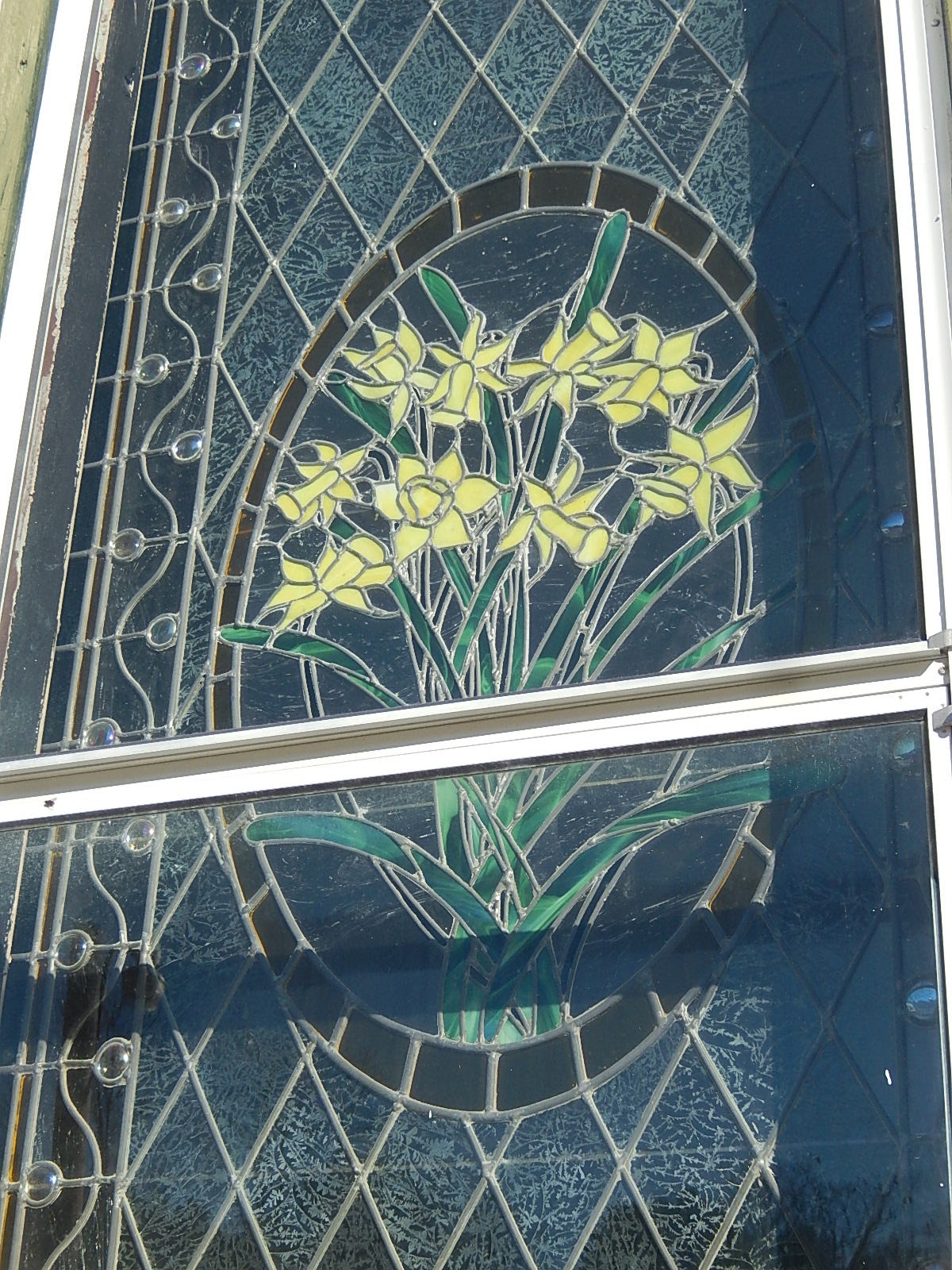
Through the visit, I felt as indrawn as the old people that drop their heads on their own chests and pull the wings of garments over their heads.  I’ve got to get out of this house, out of myself.  And I did get out.  On the day after Easter before the sleepers in the house awoke, I walked along the edge of Potter woods and down West Mountain Road to the church Mom and I drove past yesterday.  Made of concrete, stolid and simple, I noted that it seems to lack anything interesting or graceful.  But when I looked closer at the stained-glass windows, I was so surprised:  in the window glass were spring flowers!  Flowers instead of the usual saints, apostles and bearded churchmen.  I thought of the way flowers come up in waves:  crocuses, hyacinths, daffodils, tulips, roses (much later).  Each kind has its season.  Do the daffodils come up envying the grape hyacinths?  Do they come up to make their presence known?  I don’t think so.  They abide gracefully whether anyone sees them or not, and most people tromp on the violets hidden down deep in grass busy growing.  Only poets listen when flowers whisper, and, look!, the artist who made this window created a monarch butterfly, flitting above the irises.  As I thought about the secret language of flowers, it’s the Shakespearean heroines, Ophelia and Perdita, who come into my mind.  Today I know why they chose to speak with flowers and not words.  Maddened by neglect and abandoned to loss, they couldn’t trust the currency of language, and what they had to say was too fresh, too dirty, too rooted. 


Back home in Flint, I wander through Macy’s with my daughter Katya.  Passing the perfume counter, I spray some Chanel No. 5 on my pulse points  It is one of Mom's favorites, and Katya leans in to smell me as if I’m a flower.  “Did you see the old bottle in Grandmom’s bedroom?  I found it when I was climbing over the piles.  Probably it had expired."  I tell her how I wish I’d taken it, and she replies, “I want you to have a scent that I identify only with you.  I don’t want you to smell like Grandmom.”

Thursday, April 5, 2018

I will keep you wherever you go, and will bring you back to this land (Gen. 28:15)


I press my lips to her cheekbone.  Much of her face is sunken in, but I love what remains.  If thoughts are prayers, I pray that this is not the last time.  We go through our anxious exchange that’s become routine, “I love you.”  “I love you.”  “Thank you so much for everything.”  “Thank you, too.”  It’s hard to distinguish whose is the initiating voice in this call and response that is like a liturgy or a song.  “Now what are you going to do as soon as you get home?”  “I promise that I will call.”  “Good.”  I smile and wave as I walk through the door, turning back again and again.  There is a character in mythology—a poet named Orpheus—who lost his beloved to death forever just because he looked back, clinging to the sight of his wife reclaimed from the underworld, in a show of love.  Just as I’m out of sight, the call comes, “Mary Jo?”  I rush back—“Here I am!”—only to hear one more question, “did you lock the house?” 

I know I’ll miss even what I’ve come to think of as anxiety when I don’t hear her call anymore.  I wish she would ask me something significant, something important, “leave your husband and daughter and take care of me.”  “Take your profession—all your class notes and published essays—and burn them atop a mountain that I will show you.”  I need something with a biblical charge to show my love, but maybe covenant exists in the more mundane calls I receive and the reassurance I can give here on this bank and shoal of time.

My small family of three (Paul, Katya, and I) sat with her table-mates at the Home of the Good Shepherd—Nancy, May, and Flo—as they poked around the edges of their plates.  My mother didn’t touch her food which will quickly be taken as “failure to thrive” in the place she calls prison.  Paul breaks the silence, “Do the residents still have homes?  Do they talk about their lives before they came here?”  Flo, who is part Welsh and part Italian, is quick to answer, “No, that’s private, and to ask about it would be considered probing.”  Later in the car, I remind Paul that Mom says most lunches pass in silence, and he wonders aloud again whether it’s because there is shame in being consigned to this waiting room, which will be for many, their last on earth.  “I’m getting a mental hospital vibe,” said Katya when she walked, for the first time, down the corridor to Room 106, past the faux painting of two running horses, which strikes me as a mockery of those residents who are not asleep in their wheelchairs but can only self-propel with small movements of their feet, slowly, slowly.


Paul pulls the car under the carport, and I wheel her to the spot where she can stand to grasp the door handle and pull herself up, swivel around, and lift her legs into the car.  “There.  Now, where are my cigarettes?”  I place the pack of Kools in her hand, “Oh, thank God.”  Her cigarette lit, she inquires, “where to now?”, and we tell her that Paul wants to drive east along the river looking for a cemetery in the woods somewhere outside of Stillwater.  In rain turning to snow we glide, skirting the edge of the Hudson with hills covered in brown furze like an animal hide running out in undulating strides on either side.  There is a gentleness to this landscape that has been farmed since the late eighteenth century as the stones in the graveyard indicate, and part of the gentleness lies in the easy way you can cross and recross the wide river, and find, if not quite the same, a similar world on either side.  The big comparisons and allegories form in my head, but I keep them to myself.  What Mom verbalizes between courteously spaced cigarettes (so Katya doesn’t start complaining about her lungs looking like walnuts from second-hand smoke) are memories:  being lost out in this country when she and Jenny went to get apples, buying the railroad carriage lamp in the Greenwich hardware store.  I listen and keep looking at the horses standing in the sleet on the sides of hills quiet as candles.  A group of them around a trough of some kind (but not eating) regard us seriously.  “Mom,” I venture, “don’t horses want to get out of the rain?”  “No.  I don’t think it bothers them.”  We round a bend, and I see one—it must be a young one—in what I imagine to be a burst of excitement gallop up a hill, its roan rump working hard and blond mane flying.  She remembers the summer she went out to Colorado to take college courses and to ride horses (even though she’d grown up on a farm).  She remembers taking care of the horse she was assigned.  “What was its name, Mom?”  “Always.”  As if my imagination were godlike, I’d give her a new horse—let’s call him Secretariat—when he lived he won the triple-crown and she took her four little kids down to Saratoga to watch him work out, teaching us to love his combination of grace and power.  I see her on some such horse—Secretariat, Goldie, or Always—outpacing death, and fording in an easy leap the rocky stream that prevents our red SUV from going any further down the road behind a muddy farm.  “I wanna go home,” my daughter whines, “we’re out in the middle of scenic nowhere and we’ve been driving for three hours.”  She quiets after a quick stop at the Stewart’s gas station and store in Greenwich where we pee and pick up a warm container of mac n’ cheese for Katya and a cup of black coffee for Mom, who has lit up again and blowing smoke out the two-inch crack in the window. 

Car rides always were the place where I felt most at home with my mother, coming at things obliquely—horses, cows, and all kinds of curious creatures—without the stress of eyes meeting and needing the response of eyes.  On our car ride today, just like the thousands I’ve taken with her over the course of our shared life, the landscape rolled out behind and before us—the world opened up and we looked forward to what is around the next bend.  “Oh my goodness,” she says, as we approach the store that sells wood stoves in East Argyle, “that’s where we took pictures of those animals.”  The big brown cows basking in the warm sun of late February.  She remembers the cows although I'd bet dollars to donuts she doesn't remember me.  But I don’t need recognition and am not ashamed of my nothingness.  My hands were on her shoulders in the sunlight, and that is all that matters.  Wherever you go I will go.  I promised.  “Do you fear what’s to come after death,” a bold interviewer asked the intrepid traveler, Freya Stark.  “What’s to fear?  It’s just another journey.”  And while I would never say this aloud to my mother, one day along a road she’ll have to go alone, I know a barn door will open and the voice of He who knows the mountain goats’ birthtime, who opens the storehouses of snow in April to make “poor man’s fertilizer” will call, “Midge,” and she’ll go home to work right alongside Him as she did with Grampy.  For the time being, home is a Subaru Forester as cozy as the train car that rocked lazily from side to side as it inched across the Kazakh steppe, and I ate chocolate with Katya and drank cognac with Paul.  As cozy as the train car Mom remembers, filled with music, when Isaac Stern en route to a performance in St. Louis, invited Mom, her mother, and her cousin Mildred into his compartment to listen to him play his violin.


On a drive with Mom the last day of February.  Cows in East Argyle.


We stopped in this cemetery in the middle of farm fields.  It was snowing on April 3.

Latest ebay find:  Secretariat working out at Saratoga c. 1972.  It might have been the same summer I remember the long-legged chestnut beauty being led off the dirt track.  I remember my mother's awe.
Still wild, still natural.  Secretariat with his trainer.